

R3 Stem Cell Publishes Landmark Peer-Reviewed Study in Frontiers in Cell and Developmental Biology
R3's Research Paper Defines Optimal Needle Parameters to Maximize Stem Cell Viability During Injection, Offering Critical Guidance for Clinicians Worldwide
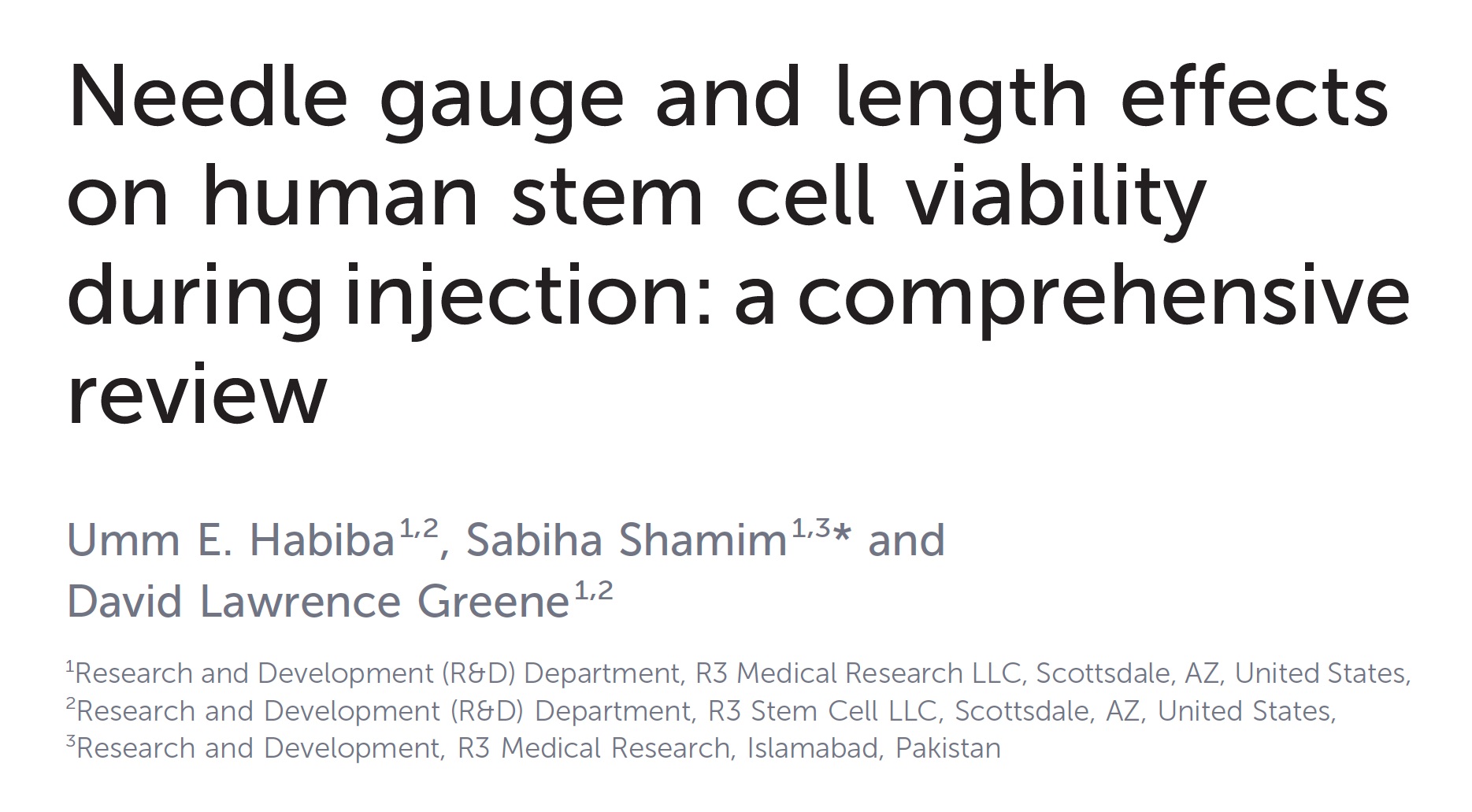
SCOTTSDALE, AZ, UNITED STATES, June 2, 2026 /EINPresswire.com/ -- R3 Stem Cell, the world's leader in regenerative medicine research and patient care, today announced the publication of a comprehensive peer-reviewed study in Frontiers in Cell and Developmental Biology (Impact Factor: 4.3; CiteScore: 11.4). The paper, titled “Needle Gauge and Length Effects on Human Stem Cell Viability During Injection: A Comprehensive Review,” addresses one of the most overlooked variables in stem cell therapy — the mechanical damage cells sustain during the injection process itself.
The problem addressed in the research is that up to 95% of cell loss occurs with suboptimal injection technique. While stem cell therapies have shown tremendous clinical promise, a critical gap has persisted in understanding how the physical act of injection affects therapeutic outcomes. The new R3 research confirms that cell death during injection can exceed 95% when improper needle parameters are used — a finding with profound implications for the efficacy of treatments being administered globally.
The study demonstrates that shear stress — the primary mechanical force acting on cells as they pass through a needle — increases proportionally to the inverse cube of needle radius. Even small reductions in needle diameter can therefore cause exponential increases in cell damage.
The comprehensive review analyzed existing literature and clinical data across multiple stem cell types and delivery contexts. Key findings include:
• Optimal needle range identified: Needles in the 21G–23G range with standard lengths (25–40 mm) and moderate injection rates (0.2–0.4 mL/s) achieve greater than 85% mesenchymal stem cell (MSC) viability — the most commonly used cell type in clinical applications.
• Smaller needles require slower rates: Needles below 27G can still cause 15%–30% viability loss even with optimized technique, and must be paired with significantly slower injection rates to partially offset damage.
• Shear stress thresholds defined: Less than 50 Pa produces minimal damage for most cell types; greater than 1,000 Pa causes substantial damage across virtually all cell types studied.
• Carrier medium matters: Suspension in type I collagen versus PBS demonstrated near 100% viability across multiple needle gauges for muscle-derived cells, highlighting the importance of delivery vehicle selection.
• Intra-articular clinical validation: A meta-analysis of 6 randomized controlled trials showed significant improvement in WOMAC scores at 12 months for intra-articular MSC injections, with doses of 25 million cells or fewer producing statistically significant outcomes.
• Cardiac delivery success: Human umbilical cord MSCs delivered via 30G intramyocardial injection survived in murine myocardium for at least 28 days with significantly improved cardiac function.
• Neural delivery safety confirmed: A Phase I MS trial using 30G intracerebral delivery reported no treatment-related deaths or serious adverse events over 12 months, with recovered cells retaining normal growth and differentiation capacity.
“This research fills a critical gap in clinical practice. The injection technique used to deliver stem cells is just as important as the cells themselves. Our findings give practitioners clear, evidence-based parameters to dramatically improve the number of viable cells reaching the target tissue — which directly translates to better patient outcomes," according to R3 Stem Cell CEO David Greene, MD, PhD, MBA.
The authors provide actionable, application-specific recommendations for clinicians across a broad range of delivery sites, including intra-articular, intramyocardial, intradermal, intervertebral disc, and intracerebral injections. The study calls for standardized reporting of injection parameters in clinical trials, mandatory pre- and post-injection viability testing, and adoption of syringe pump systems for controlled infusion rates.
The research also identifies emerging technologies — including microfluidic delivery systems and protective encapsulation strategies — as promising future solutions that may enable smaller needle use without viability compromise. According to lead R3 Stem Cell researcher and author Umme Habiba, PhD, "Our providers globally have been asking the research team to provide insights on the question of optimal needle size, gauge, and injection velocity. So we evaluated the problem, came up with the best practice protocol, and now our global team in eight countries will continue with the most effective regenerative therapies available."
R3 Stem Cell LLC is a Scottsdale, Arizona-based regenerative medicine company dedicated to advancing the science and clinical application of stem cell therapies. Through its R&D division, R3 Stem Cell Research, the organization conducts original research, develops evidence-based clinical protocols, and educates practitioners on best practices in regenerative medicine. R3 Stem Cell is committed to improving patient outcomes through scientific rigor, translational research, and innovation.
As the world's largest provider of stem cell and exosome therapies, R3 has performed over 29,000 regenerative procedures in eight countries with an 85% patient satisfaction rate. R3 is the largest provider of stem cell treatment in the USA, South Africa, Philippines, Turkey, Mexico, UAE, India and Pakistan. Over 50 conditions are treated internationally, including stem cell treatment for autism, stroke, diabetes, heart disease, kidney/liver/lung failure, arthritis, and exosomes for anti aging too.
Website: www.r3stemcell.com | Email: info@r3stemcell.com
David Greene, MD, PhD, MBA
R3 Stem Cell International
+1 888-988-0515
email us here
Visit us on social media:
LinkedIn
Instagram
Facebook
YouTube
Legal Disclaimer:
EIN Presswire provides this news content "as is" without warranty of any kind. We do not accept any responsibility or liability for the accuracy, content, images, videos, licenses, completeness, legality, or reliability of the information contained in this article. If you have any complaints or copyright issues related to this article, kindly contact the author above.
